A collection of wildlife-themed photographs from Assam Province in northeast India. This is a content-heavy web page and dependent on your internet connection may take some time to fully load. Please be patient. 🙂
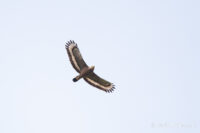
The crested serpent eagle (Spilornis cheela) is found in forested habitats across tropical Asia and is not considered to be a threatened species.
Its range is widespread across the Indian Subcontinent, Southeast Asia and East Asia, with 21 populations regarded as subspecies.
Whilst they often feed on snakes, hence their name, they also prey on lizards, birds, amphibians, mammals and fishes.
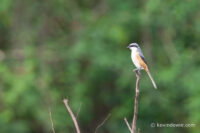
The grey-backed shrike (Lanius tephronotus) is found in the nothern and north eastern states of India, Nepal, Bhutan, China and Yunnan.
It’s believed they breed at the highest altitude of all the shrike species. Given its relatively wide distribution and no apparent evidence of declining numbers, it is are not considered to be an endangered species.
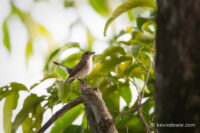
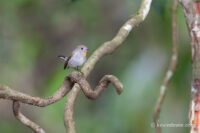
Little Pied Flycatcher. The female (pictured) is more drab in colouring than the male. Photographed in Assam State in India, the species is not considered to be endangered.
The little pied flycatcher (Ficedula westermanni) is found in the Indian Subcontinent and Southeast Asia, as far east as Indonesia and the Philippines. It is not considered to be a threatened or endangered species. This individual, a female, was photographed in Assam State, India.
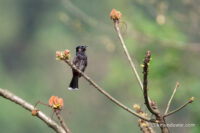
The red-vented bulbul (Pycnonotus cafer) is a resident breeder across the Indian subcontinent, including Sri Lanka extending east to Burma and parts of Tibet.
It has been introduced in many other parts of the world where it is considered an invasive pest partly due to their habit of damaging fruit crops and dispersing the seeds of invasive plants.
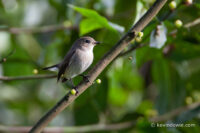
The Himalayan or White-cheeked Bulbul occurs in the northern regions of the Indian subcontinent and parts of central Asia. This individual was photographed in the north eastern Indian state of Assam and is considered a common species.
The taiga flycatcher or red-throated flycatcher (Ficedula albicilla) is a migratory bird. Breeding in North Eurasia from Eastern Russia to Siberia and Mongolia, it is a winter visitor to South and South-east Asia in the Indian Subcontinent and Southeast Asia.
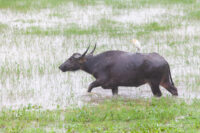
Egret riding water buffalo, Assam, India
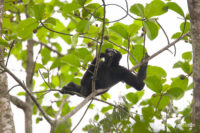
Hoolocks are found in Assam in North-East India, Myanmar (Burma) and in small numbers in eastern Bangladesh and southwest China. They live in monogamous pairs, which stake out a territory and use their calls to locate family members and deter other gibbons from their territory. The species is considered endangered with their numbers falling by about 90% since the early 1970s. It’s believed there are less than 5,000 left.
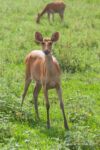
The barasingha (Rucervus duvaucelii syn. Cervus duvaucelii), also known as the swamp deer photographed in Kaziranga National Park, Assam, India. This is a vulnerable species with a total population of less than 2,150 individuals in India and about 1,600 in Nepal. The distribution of the species is much reduced and fragmented due to unregulated hunting and conversion of large tracts of grassland to cropland between the 1930s and 1960s.
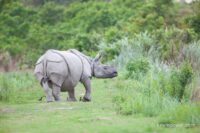
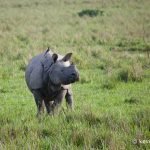
Indian Rhinoceros followed by Myna birds. A symbiotic relationship, Kaziranga National Park, Assam, India.
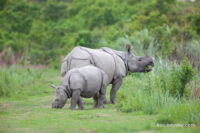
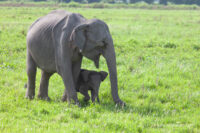
Indian Rhinioceros, mother with calf, Kizaranga National Park, Assam, India
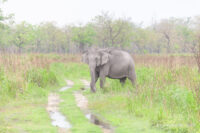
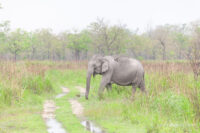
Indian Elephant crossing track, Kaziranga National Park, Assam, India
Indian Elephant crossing track, Kaziranga National Park, Assam, India
The Indian elephant (Elephas maximus indicus) is one of three recognized subspecies of the Asian elephant and native to mainland Asia. Listed as Endangered by IUCN, the population has declined by at least 50% over the last 60 to 75 years or three generations.
The main threats to Asian elephants today are habitat loss, degradation, and fragmentation, which are driven by an expanding human population, and lead in turn to increasing conflicts between humans and elephants when elephants eat or trample crops. The exploitation for ivory and the associated poaching remains a grave concern.
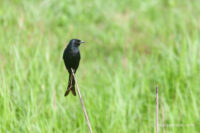
The black drongo (Dicrurus macrocercus) is a common species in much of tropical southern Asia from southwest Iran through India and Sri Lanka east to southern China and Indonesia. The species is territorial and known for its aggressive behaviour towards much larger birds, such as crows. The species has been introduced elsewhere where it is considered something of a pest.
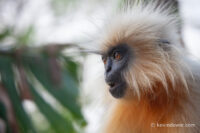
Gee’s golden langur (Trachypithecus geei), or simply the golden langur, is found in a small region of western Assam, India and in the neighboring foothills of the Black Mountains of Bhutan. One of the most endangered primate species of India, in 2001, the total Indian population was estimated at 1,064 individuals, in 130 groups. This individual was photographed on Umananda Island near Guwahati on the Brahmputra River, where there is a colony of about 20.
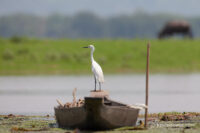
Cattle egret perched on boat. Assam, India
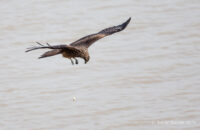
Black-eared Kite drops its meal whilst on the wing, Assam, India.
Lesser Whistling Duck, Assam Provence, India.
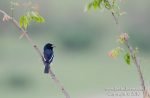
Oriental Magpie Robin, Assam, India.
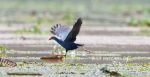
Purple Gallinule running, Assam Provence, India.
The Indian rhinoceros (Rhinoceros unicornis), also called the single horned rhinoceros, greater one-horned rhinoceros and great Indian rhinoceros, is native to the Indian subcontinent. Historically the species was widespread across northern India, however, excessive hunting and agricultural development reduced their range drastically to 11 sites in northern India and southern Nepal.
In 2015, a total of 3,555 Indian rhinoceros are estimated to live in the wild, the species is considered vulnerable to extinction.
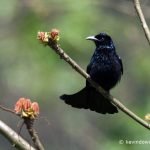
The hair-crested drongo (Dicrurus hottentottus) is native to India and Bhutan through Indochina to China, Indonesia, and Brunei.
Previously it was known as the Spangled Drongo (Dicrurus bracteatus), that name is now applied only to the Australian sub-species.