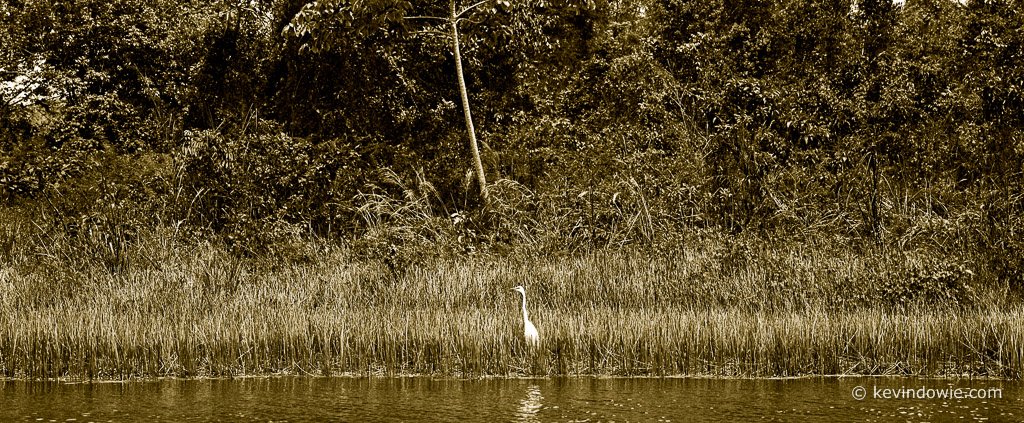
Today’s image was taken in Guatemala near Flores and depicts a single white egret at the water’s edge. Originally shot on 6×7 colour negative film, I decided to crop the image down, leaving out some featureless water in the foreground and also some of the vegetation at the top of the frame. I think the panoramic format follows the horizontal lines in the image, the line of the water’s edge, the line of the reeds and the line of the longer grasses behind them. In most images, particularly monochrome, the eye is drawn to the brightest or highest contrast element in the scene, in this case the egret. If by chance your eye isn’t immediately drawn to the egret, then the bright thin tree trunk in the background acts as a pointer to lead you there.
I didn’t record the camera settings used but believe I used the 150mm lens in this case, the angle of view being equivalent to a 72 mm lens on a full frame 35mm camera, so short telephoto. The image was taken from a slow moving boat so shutter speed would have been about 1/250 second to overcome camera movement.
Mamiya 7 mk 2 with 150mm lens on Kodak 160VC colour negative film.
Digital cameras, choice of brand and model.
Following up from my last blog entry, where I described when and why I switched from film to digital cameras, today I continue the story as to what choices I made when going digital.
From time to time people ask “what camera do you use?” Well the simplest way to figure this out is to read the captions that I provide under the blog images! Another question may be why one brand or model rather than a competing brand or model? This is the subject of so many posts in blogs and camera site forums that it’s amazing, and often quite silly too. People seem to associate themselves with a brand or identify with a brand and become quite defensive about their choice. Some of the resulting debates boil down to childish “my camera’s better than yours’, “no it’s not”, “yes it is too” nonsense. A bit like when I was 8 years old and in the schoolyard arguing with my mates “my football team’s better than yours”, but at least back then there was no question that I was right! (Still am….go tigers!)
With the advance of digital photography there were two companies that really stood out when I was deciding, Canon and Nikon. Canon at that time were the leader in terms of market share for what that’s worth, but I’d had no previous experience with using either brand. In my film days I’d used Pentax 35mm gear and Mamiya medium format gear but neither of these companies had a suitable digital offering at that time. In the years that followed both these companies and others, notably Sony, would introduce interesting digital products.
So I went with Canon. Why Canon and not Nikon? I always believed that I would ultimately go for a full frame sensor DSLR. The full frame sensor would offer inherently better image quality over a reduced frame sensor. Megapixel counts would increase with each new model but physics dictates that if those pixel sites are made smaller and smaller and crammed closer together then the problem of interference arises. This interference becomes apparent in the image file as “noise” or distortion at the fine detail level of the image. People get obsessive about megapixel counts, more pixels means better image, right? Well not necessarily. Take two cameras each of say 10 megapixels. They should produce the same quality of image when printed up to a reasonable sized print, right? Well if one camera has its 10 megapixels spread out over a full frame and the other has its 10 megapixels crammed onto a reduced frame sensor, then the first one will perform better. Why? Because the same amount of information (signal) is being gathered, but in the reduced frame sensor there is more interference or “noise”. This signal to noise ratio impacts on image quality, becoming particularly apparent in high ISO images.
So back to the earlier question why Canon and not Nikon? Both companies have really good reputations for build quality and performance and produce excellent lenses too. However at the time of my moving to digital, only Canon offered a full frame sensor camera, the 1DS mark2. Nikon had no full frame sensor available and there was no indication of them having one available in the, then, foreseeable future. Indeed, they appeared to be committed to reduced frame DSLRs. Did I get the 1DS mark 2? No. It was just too expensive for me to justify so, after all the research I did about the significance of sensor size, I did buy a reduced frame SLR, the Canon 20D. As I developed my kit of digital gear I was intent on ignoring reduced frame lenses and only went for full frame lenses believing that I ultimately would purchase a full frame camera. With the rapid advances in camera technology that were occurring, and with Canon pursuing the full frame concept, it was logical that their next move would be the introduction of a more affordable full frame 35mm DSLR. The Canon 5D was that camera and for me it ticked most of the boxes. I now use both the 20D and the 5D.
The same decision today?
If I was starting out in digital today, I think the decision could be tougher. Nikon have now produced their own full frame camera and the technology has moved forward even further. The decision today, if starting out from scratch would be based as much on the choice of lenses available as the cameras themselves. Each company produces great lenses one of which is Nikon’s 200-400mm zoom which has an excellent reputation and would be a great choice for wildlife and safari use. In addition to the “big 2″, Sony have now entered the market with a vengeance and would also be considered.
Comments welcome, but be warned, any comment containing the phrase “my camera’s better than yours” will be ignored. Oh, and my football team IS better than yours, so don’t try that one on either (chuckle). KD.